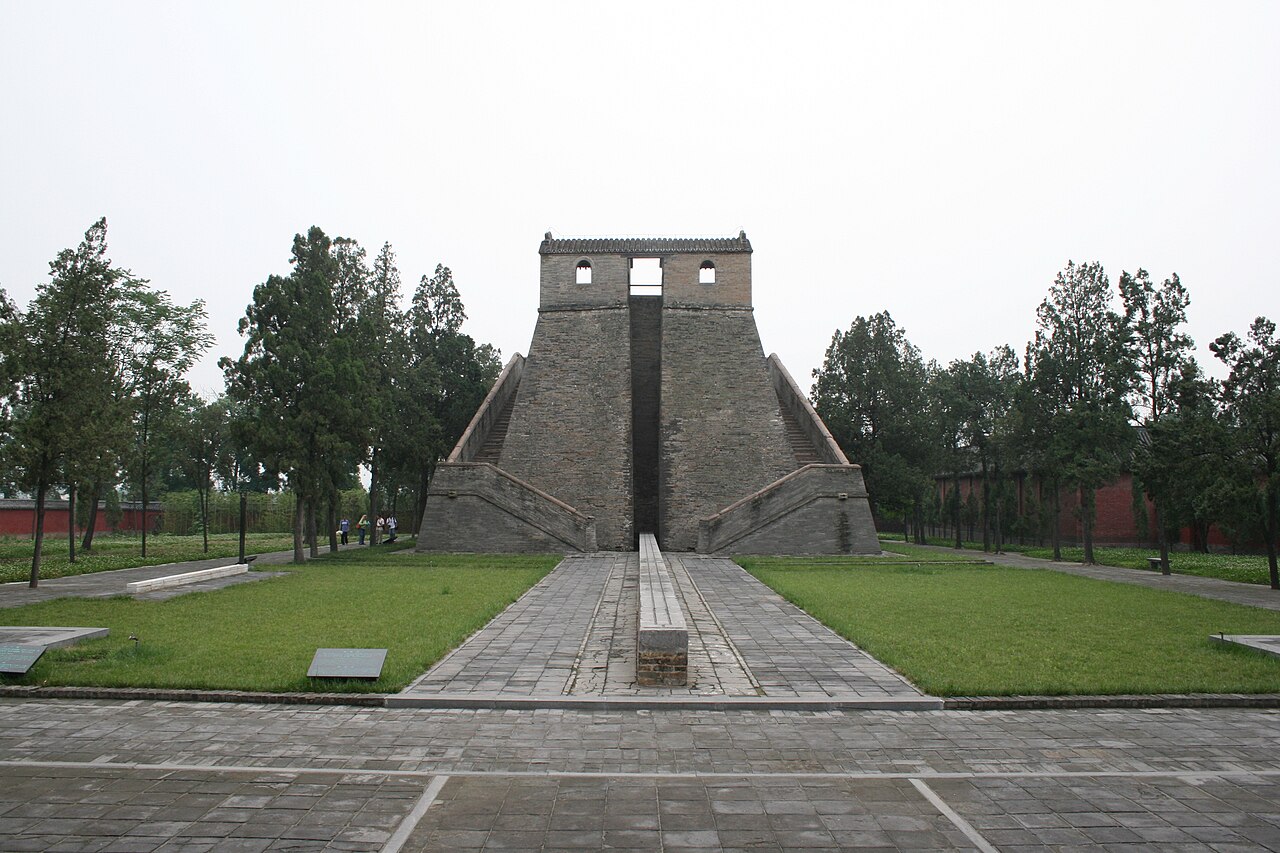
The instrument is bigger than you expect
An observatory does not have to begin with a telescope. At Gaocheng (告成), outside Dengfeng (登封) in Henan, a broad brick structure faces a long strip of stone. From the published photograph, the strip might first look like a path. It is part of the instrument. UNESCO’s astronomy account describes a horizontal gnomon and a measuring scale about 31 metres long, used to measure the Sun’s noontime shadow. [2]
That changes the visit. Instead of looking for a small scientific object inside an old building, look at how the building and ground work together. The architecture supplies a reference; the scale gives the shadow somewhere to be measured. What appears monumental is also a device for attending to something that moves.
A shadow is an observation, not yet a calendar
Imagine making a mark and returning to it repeatedly. One shadow gives you one observation. A sequence lets you compare. The useful subject here is not a single beautiful line on a sunny afternoon, but the discipline of making positions comparable across time. This is our way into the site, not a reconstruction of an observing session we have witnessed.
The local government’s cultural account describes the stone scale, or 石圭, as extending north from the observatory, with channels along its surface. It connects Guo Shoujing (郭守敬) and Wang Xun (王恂) with the observations and calculations behind the 授时历, the Shoushi calendar promulgated in 1281. [3]
The distinction between observing and calculating is worth keeping. The monument is not a giant calendar page. It is evidence of the work that allows a calendar to be made. Do not promise yourself a working historical demonstration just because a photograph shows a clear sky. Cloud, conservation barriers, present equipment and the day’s programme may change what is visible.
Why call this the centre of heaven and earth?
UNESCO’s account of the wider Dengfeng property links astronomical ideas of a centre with sacred Mount Songshan (嵩山) and the authority of rulers. The observatory belongs to a serial World Heritage property alongside ritual, educational and religious sites. This is not a claim that modern geographical science locates a physical centre of the world here; it is a record of a powerful historical conception. [1]
Our interpretation: measurement and authority need not be opposing stories. A place could gain prestige through its association with knowledge of the heavens, while its instruments still demanded careful practical work. A useful visit makes room for both: how the observation was organised, and why that location mattered to its patrons.
Two monuments, different dates
The name Zhougong Sundial Platform (周公测景台, also written 周公测影台) can invite a misleading shortcut. A monument associated with the Duke of Zhou is not automatically a surviving structure from his lifetime. The government account dates the stone platform to 723, in the Tang dynasty. Its historical association and the date of the standing monument should be kept separate. [3]
The World Heritage nomination dossier dates construction of the larger Yuan observatory to 1276–79. It also records later work, including Ming-period alterations and twentieth-century repairs after damage. An old scientific site is not an untouched machine left outside time. Ask which elements are historic fabric, repaired components, later additions or interpretive replicas, rather than assigning every visible stone the same age. [4]
UNESCO lists the observatory as its own component, 1305-008. The other Dengfeng monuments are dispersed rather than sitting behind the same entrance. A World Heritage designation is therefore not an all-in-one walking itinerary or a guarantee of one combined ticket. [5]
A half-day route from Dengfeng
This is a proposed route, not a firsthand-tested tour. Base it on a Dengfeng hotel pickup and an agreed return. Reserve a half day locally; use another day for a demanding mountain or temple itinerary rather than compressing this into a transfer stop.
- Before leaving — book the actual destination. Save 河南省郑州市登封市告成镇观星台. Ask your accommodation or a licensed local provider to confirm the entrance, that day’s opening and any reservation or identification requirement. Agree pickup, waiting, parking and return costs in writing. The plan assumes arranged return transport, not an unverified through bus.
- First stop — the Zhougong platform. Allow around 25 minutes as a planning budget. Read the date and instrument labels before taking a photograph. Separate the person commemorated from the age of the monument. Follow the permitted visitor route rather than a presumed historic sequence.
- Second stop — the Yuan observatory and stone scale. Give this roughly an hour. From accessible ground-level paths, compare the mass of the tower with the narrow measuring line. Try identifying their alignment without stepping onto the scale. Upper-level access is optional and must be confirmed; the visit does not depend on climbing.
- Third stop — interpretation, then a return look. If the relevant halls or displays are open, allow another 20–30 minutes for labels, instruments and repair history. Then return to one permitted viewpoint and make a second sketch. If displays are closed, use that time to compare the two monuments instead.
- Return to Dengfeng for lunch. These are suggested on-site allocations, not an official tour duration or road-time estimate. Confirm the full transport window before attaching the visit to a train or long-distance departure.
What we have not verified for your date
Official heritage and visitor introductions establish the site and its main monuments. They do not provide a verified October 2026 timetable in the records reviewed here. We therefore quote no current admission price, bus departure, guaranteed tower access or live observing event. Ask the operator directly about temporary closures, steps, toilets and indoor interpretation before travelling. [6]
Do not plan an evening stargazing visit merely because the English name says “observatory”. This route concerns a historic complex and daytime solar measurement. Night access or a telescope session would require a separately confirmed programme.
Bright sun may make shadows easier to notice, but the instrument’s purpose can still be read through its arrangement and labels on an overcast day. Do not cross barriers or handle historic surfaces to recreate an experiment.
Take a better question, not an invented performance
Ask a guide to explain the relationship between the shadow-casting reference and the stone scale, the difference between the Tang platform and Yuan observatory, and one documented repair. Those requests are more useful than demanding that an ancient instrument deliver a perfectly timed result on arrival.
我们想从登封市区往返告成镇观星台,重点看周公测景台、元代观星台和石圭。请确认当天开放时间、门票或预约要求、台阶及无障碍情况、允许参观的区域、讲解安排和接送等候费用。我们希望了解测影方法、不同年代与修缮历史,不需要未确认的夜间观星活动。
For a shorter visit, keep the two instruments and drop optional displays. The point is the comparison, not the number of rooms entered. A calendar can feel abstract; the long scale gives you a place to ask how repeated looking becomes shared time.
Build the detour into your trip
Use our existing enquiry form with your date, starting hotel, party size, walking requirements and onward journey. Guiding, transport and personalised coordination are separate services, subject to confirmation. Membership does not include them.
Send your trip brief ↗Browse the PDF guide shelf ↗Explore member cultural deep reads ↗Official sources & further reading
- UNESCO: Historic Monuments of Dengfeng — Inscribed in 2010; the relationship between astronomy, sacred geography and political authority.
- UNESCO: Astronomy and World Heritage — The observatory’s horizontal gnomon and roughly 31-metre measuring scale; checked 17 October 2026.
- Dengfeng government: observatory cultural account — 16 August 2024, republishing Zhengzhou Evening News; local names, instrument description, Tang platform and calendar history. Not a current opening-hours notice.
- China’s World Heritage nomination dossier — Observatory history, construction dated 1276–79 and later repair campaigns. Historical nomination material, not a visitor timetable.
- UNESCO: component maps — Observatory listed as component 1305-008, separate from the other Dengfeng monuments.
- Dengfeng government: visitor introduction — 18 February 2022; the main monuments. Does not establish October 2026 admission, opening hours or access to upper levels.
- Gary Todd: observatory photograph — 11 June 2010; CC0 public-domain dedication. Resized; page displays may crop. Not evidence of current site conditions.