The approach is part of the object
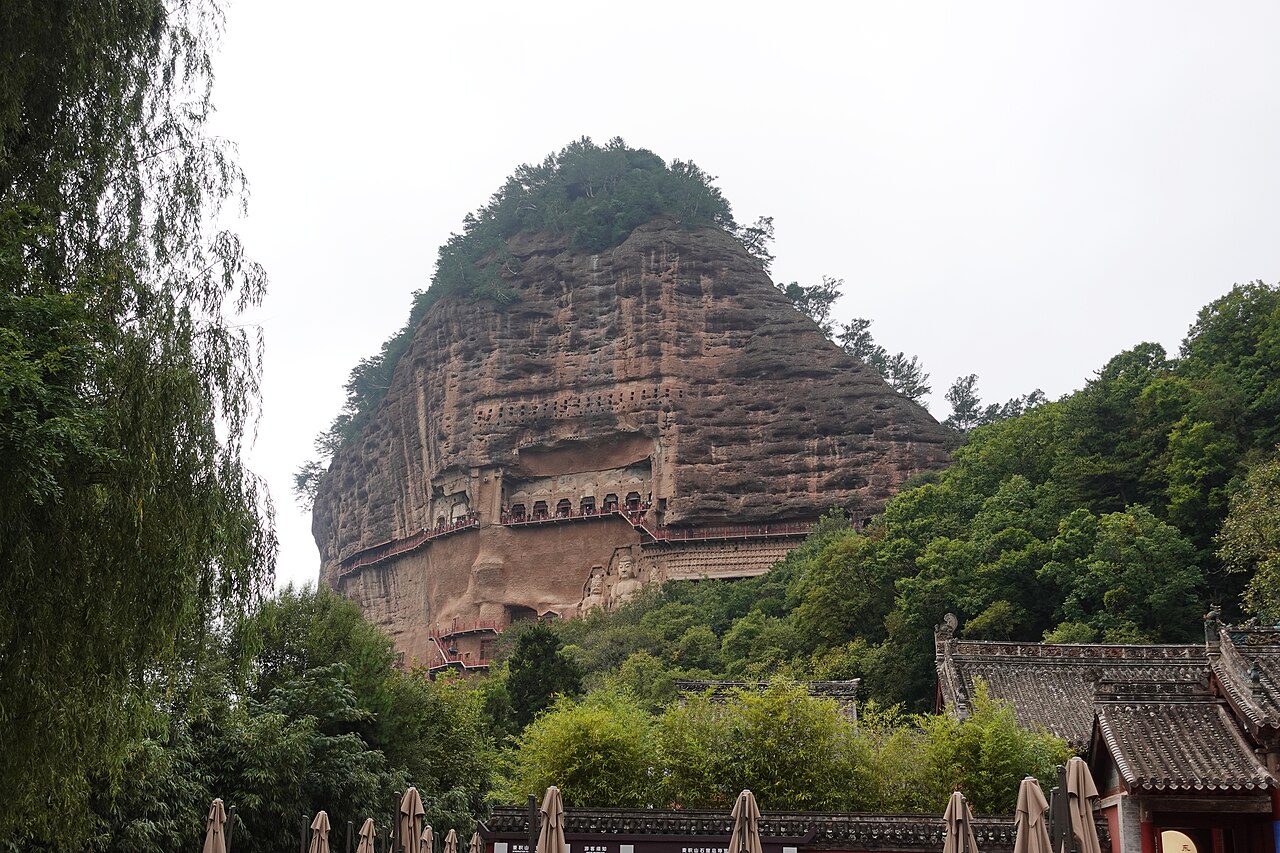
Maijishan looks like a haystack only from a distance. Close to the cliff, the metaphor gives way to a constructed surface: openings cut into reddish rock, ledges, roofs and narrow routes joining one chamber to another. A cave can be described as an interior, but here the movement between interiors remains visible on the mountain’s face.
The Maijishan Cave-Temple Complex (麦积山石窟) is a component of UNESCO’s Silk Roads: the Routes Network of the Chang’an–Tianshan Corridor. China’s Ministry of Culture and Tourism describes 221 caves, more than ten thousand clay and stone figures and nearly one thousand square metres of murals. Those totals establish scale. They do not mean every cave is open on a given day. [1]
The distinctive question is not simply what survives inside. It is how a vertical religious landscape became reachable at all. The visitor encounters sculpture through an architecture of access, and current access is shaped again by conservation and crowd control.
Clay makes the cliff less permanent than it looks
Carving into a mountain can suggest permanence, yet Maijishan is especially associated with modelling as well as cutting. Clay figures depend on supports, surface layers and environmental stability. They occupy rock-cut spaces but are not identical with the rock. The hard cliff and vulnerable image have to be read together.
This changes the usual photograph. A frontal image of a figure can make it appear complete and isolated. In situ, a visitor also perceives enclosure, height, neighbouring niches and the route that delivered bodies to the threshold. Digital images are valuable for details, but they flatten this relation between image, chamber and exposure.
Modern monitoring adds another layer. China’s National Cultural Heritage Administration reported in 2023 that a wider cave-temple monitoring platform incorporated data from sites managed by the Dunhuang Academy, including parts of Maijishan. That source supports the existence of monitoring work, not a claim that every conservation problem has been solved. [2]
Why a half-day is better than a checklist
Tianshui’s official tourism planning links Maijishan with other cave sites and landscapes. That is useful for a longer stay, but it can tempt a first visit into becoming transport-heavy. A focused half-day gives the cliff enough time: arrival, orientation, the permitted walkway circuit, a slow return and a buffer for timed access.
Route at a glance
Base: stay in Tianshui (天水) the night before. Confirm whether your hotel is nearer Tianshui South railway station (天水南站) or the older city centre.
08:00–09:00: pre-arranged car or current public transport to Maijishan Scenic Area (麦积山景区). Do not use this article as a live timetable.
09:00–09:30: tickets, shuttle and site orientation. Keep passport details consistent with the booking channel.
09:30–12:00: follow the walkway circuit actually open that day. Prioritise one sequence of caves rather than rushing between every available number.
12:00–13:00: descend, review the cliff from below and return toward Tianshui. Add Xianren Cliff (仙人崖) only if transport, energy and opening information are confirmed.
The Ministry’s 2024 Tianshui route announcement places Maijishan within a broader “hundred-li cave corridor” and names Xianren Cliff among possible additions. It is evidence of official route framing, not a guarantee that two places combine smoothly on your exact date. [3]
Read one threshold carefully
At the first permitted cave entrance, pause before looking for a famous face. Notice the thickness of the threshold, the relation between chamber and ledge, and whether the approach makes you turn, climb or compress your body. These are not incidental inconveniences. They determine how the image is encountered.
Then separate three historical layers: the original cave and image; repairs and reconstructions across long use; modern stairs, rails and protection. A secure contemporary walkway is not evidence for the precise form of ancient access. Conversely, the present route has its own design intelligence: it must allow viewing while limiting risk to visitors and fabric.
Where photography is restricted, treat the restriction as part of the visit rather than an obstacle to defeat. A small notebook can record cave number, direction of light, figure grouping and one material question. Do not touch surfaces or lean equipment over rails.
Practical decisions before you leave
Book the site, not just the train. Public demand can be high; a 2024 Gansu government report recorded sold-out days during a holiday peak. That is historical evidence of crowd pressure, not a forecast for 2026. Use the attraction’s current official booking channel and check the permitted ID document, entry window and any separate cave or walkway rules.
Plan for height and stairs. The route involves exposed elevated walkways. Travellers with vertigo, limited mobility, heart or respiratory concerns should assess current access conditions before buying. Weather or conservation work can change the circuit.
Keep the Chinese brief visible. Show: 麦积山石窟预约入口在哪里?今天开放哪些栈道?外国护照怎么取票? — “Where is the Maijishan Grottoes reservation entrance? Which walkways are open today? How does a foreign passport holder collect or validate the ticket?”
Do not promise the second stop. Xianren Cliff is a possible extension, not a mandatory box. A deliberate return to Tianshui is better than converting the cave visit into a race against an unverified closing time.
What the route cannot establish
This article is based on official heritage records, public planning information and licensed photographs. It does not claim a firsthand visit, current ticket availability, complete cave access or an unchanged transport schedule. UNESCO component records describe heritage status and boundaries; they are not visitor-service pages.
The cliff’s visual power can make the site seem singular and self-contained. The official Silk Roads framing argues otherwise: Maijishan belongs to a network of religious, political and commercial movement. The walkway offers a smaller version of the same idea. It turns isolated chambers into a route—and reminds us that an image survives through systems of access, care and interpretation.
Official sources & further reading
- Ministry of Culture and Tourism — Maijishan Scenic Area record, site scale and heritage status.
- UNESCO World Heritage Centre — Chang’an–Tianshan Corridor component map, including Maijishan.
- Ministry of Culture and Tourism, 9 April 2024 — Tianshui’s published route network.
- National Cultural Heritage Administration, 20 August 2023 — cave-temple monitoring context.
- Ministry of Culture and Tourism — Dunhuang Academy’s management scope, including Maijishan.
Turn the reading into a workable trip
Use the existing planning service to turn railway, hotel and accessibility constraints into a realistic brief. The Quanzhou member dossier is a separate protected deep read; one-off PDFs and personal planning are not included in membership.
Request route planning ↗See membership & sample ↗