Start with the water in front of the books
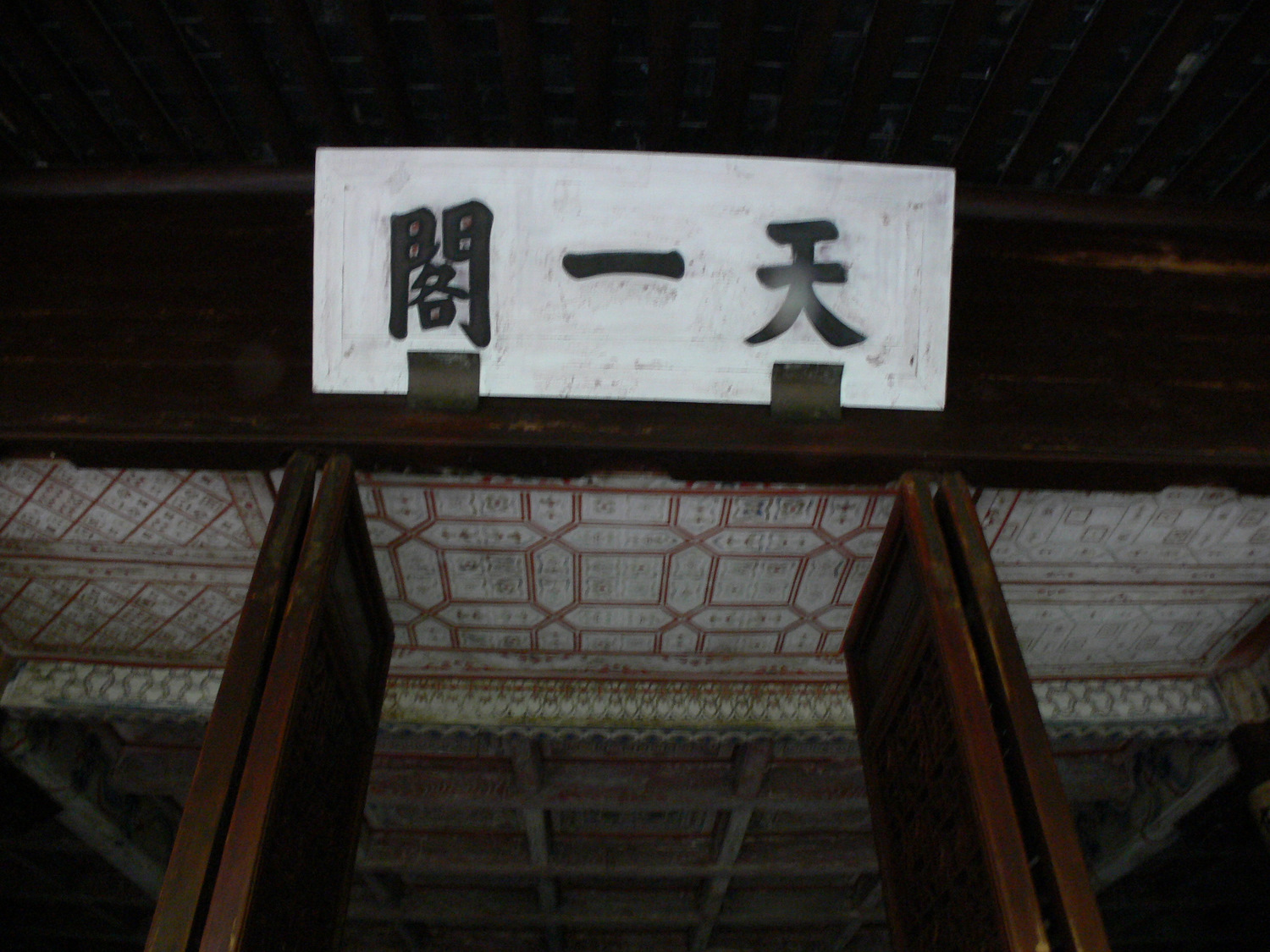
A pond outside a library can look like a decorative pause between buildings. At Tianyi Pavilion, it belongs to the story of how books survived. The official scenic-area account describes a pool dug in front of the collection building for fire prevention. It also connects the name Tianyi to an old cosmological association between heaven, water and numbers. Symbolism and practical precaution share the same small piece of ground. [1]
The interesting object here is not simply a rare book. It is a system built around keeping a collection intact: a building, water, separation from domestic space and rules about access. A Zhejiang public educational account identifies firewalls between the library and the western living area, with their doorways offset. That gives a visitor something concrete to look for beyond a picturesque roof. [2]
A private collection becomes a public subject
The site’s official architectural description dates the building to 1561–1566 and identifies the collector as Fan Qin (范钦). The surviving library is also called Baoshulou (宝书楼). These names are more useful on a museum label than the loose English category “ancient library”. [1]
The scenic administration’s historical exhibition introduction describes the movement from a family collection to shared cultural heritage. It presents family management, donations and dispersed displays across the museum grounds. This is an older exhibition description, published in 2017; it is background, not a guarantee that every installation remains on view today. [3]
Our reading exercise: ask what kind of access each space offers. Can you see a building, read a label, inspect a displayed object, or consult the collection? Those are different privileges. A museum ticket should not be treated as permission to enter historic stacks or handle books. Restricted access is part of the preservation story, rather than a disappointing omission from it.
A half-day route, with room to change it
The following sequence is an editorial proposal, not a guided tour we have personally tested. Allow about four hours including a break; the times below are planning allowances, not measured walking times.
- Arrive at Ximenkou (西门口). The scenic administration identifies Metro Line 1 and a walk along Changchun Road (长春路) as an approach. Set the destination to Tianyi Pavilion Museum (天一阁博物院), confirm the open visitor entrance and follow current street navigation. If carrying luggage, take a taxi directly to the museum entrance instead. [4]
- Give the museum roughly two hours. Begin with its historical introduction, then look at the library building, pool and the relationship between garden and collection spaces from publicly accessible paths. Copy down one Chinese name from a label and one detail about preservation. The point is to leave with a question, not a photograph of every pavilion.
- Take a lunch or tea break outside the ticketed grounds. Choose an open business on the day. Keep the museum’s entrance name saved so that you can orient yourself after the break. We do not promise a particular café, price or menu.
- Walk only the open sections of Moon Lake (月湖). The official scenic overview pairs Tianyi Pavilion and Moon Lake as the area’s two principal components. Use the lake as a change of pace after the museum, not an obligation to complete a circuit. Allow 45–60 minutes and turn back wherever signs require. [5]
- Finish before adding another destination. For an onward train, navigate to Ningbo Railway Station (宁波站) and allow your normal station buffer. A museum-and-lake afternoon is already a complete subject; it does not need an unrelated distant attraction to make it worthwhile.
Planning note · checked 14 October 2026
A 25 September 2026 local news report reproduces a scenic-office notice dated 24 September about phased Moon Lake works, including closures from 28 September. We have not independently verified the current boundary of those closures. Treat the lake walk as optional and confirm open paths with the scenic office at +86 574 83868555, the number on its official website. Reported notice [6] · Official contact [7]
The older official English visitor page and current third-party listings give different seasonal opening schedules. We therefore do not publish a fixed opening hour or ticket price here. Confirm the date, open entrance, booking requirements and identification accepted before departure; check Monday morning separately. A lake-path closure does not by itself establish that the museum is closed.
What to notice after the visit
Return to the pond in your notes. Which details were built to protect books, and which were added to present their history to visitors? A garden can be attractive and still have a job. That distinction is the route’s central idea: reading a place through what it had to preserve.
If you want to extend the subject, compare Tianyi with our Yangzhou book-and-print route. One starts from keeping a collection; the other from making and circulating printed pages. The contrast gives two cities a reason to belong in the same journey.
Source desk
- Tianyi Pavilion–Moon Lake scenic administration: library architecture and water symbolism — official historical introduction.
- Zhejiang public educational bilingual guide — 14 September 2021; library, pool and firewalls.
- Official historical exhibition introduction — 15 April 2017; older display context.
- Official English visitor and transport page — approach guidance; seasonal hours require reconfirmation.
- Official scenic overview — museum and Moon Lake.
- Local report reproducing the 24 September 2026 works notice — secondary reporting, not a live access map.
- Official scenic administration — contact and visitor notices.
Sources checked 14 October 2026. Historical material, current reporting and our proposed pacing are distinguished above. This is researched cultural travel writing, not a firsthand account. External links are to the original hosts.