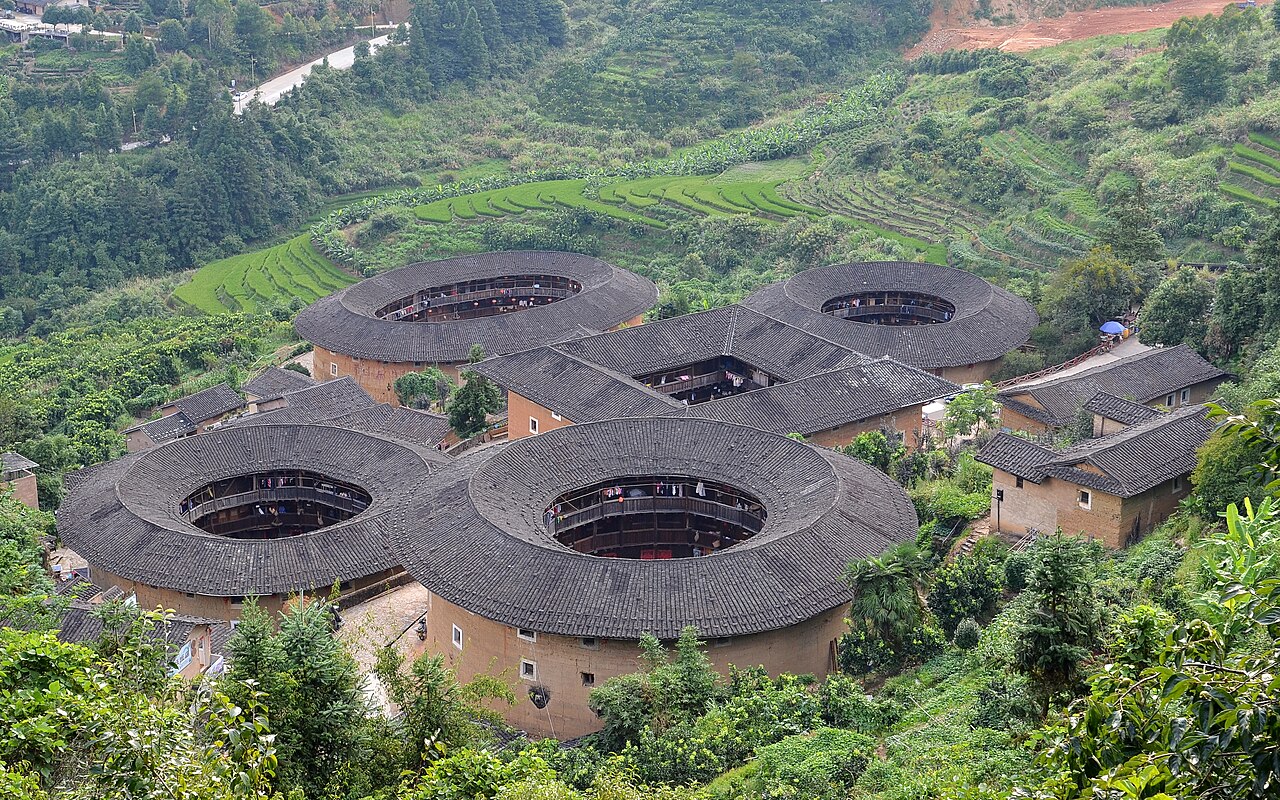
Start with the shape. Then change your position.
One square, three circles and an oval sit together on a green slope. From above, Tianluokeng (田螺坑) is almost too neatly composed: five enormous roof shapes, open in the middle, arranged like a still life. The familiar nickname, “four dishes and a soup”, turns the settlement into an image you can recognise immediately. But a rooftop arrangement cannot tell you how a household occupies a building.
The more interesting visit changes scale. Begin at a permitted viewpoint, then move towards the entrance and courtyard where access is allowed. Ask what the aerial-looking photograph leaves out: doors, stairs, divisions between families, the distance to cultivated land. This is a proposed viewing method, not a report of a journey we have personally made.
A round building is not a single round household
UNESCO describes Fujian tulou as communal earthen dwellings organised around a central courtyard, with defensive outer walls and inward-looking plans. Its account explains that households were divided vertically within the larger building. That is an important correction to the impression of one enormous shared room: collective enclosure and family boundaries existed together. [1]
Our interpretation: the courtyard is a useful starting point for thinking about shared space, but it cannot explain the whole social arrangement. Look for what is connected and what is separated. Where can a visitor stand? Which thresholds remain private? A tour ticket is not permission to follow every staircase or photograph the inside of somebody’s room.
The World Heritage inscription covers 46 buildings in a serial property, not every earthen building marketed to travellers in Fujian. UNESCO’s component maps name the Tianluokeng cluster separately from other groups. Save the exact place rather than asking a driver to take you to “the tulou”: that phrase covers a far wider landscape than one stop. [1] [2]
The mountain belongs in the story
A Fujian housing-department feature published on 23 June 2026 identifies the cluster’s five buildings as Buyun Lou (步云楼), Zhenchang Lou (振昌楼), Ruiyun Lou (瑞云楼), Hechang Lou (和昌楼) and Wenchang Lou (文昌楼). It places their composition within a terraced agricultural setting and describes Nanjing County as an area where Hakka and southern Fujian cultures meet. [3]
Do not crop the fields out of your understanding just because the buildings fit neatly into a photograph. The relation between settlement and worked land is part of the subject. A roof gives shelter; a field, path or watercourse helps explain why people could live here. Notice those relationships from public routes without entering planted ground for a better angle.
UNESCO’s inscription decision already warned in 2008 about visitor pressure and the protection of the wider setting. That is a historical conservation concern, not a claim that a particular crowd or restriction exists today. It does suggest a better question than “where is the best photo?”: what does a good visit leave undisturbed? [6]
A focused route: one full day after arriving locally
Use Shuyang Town (书洋镇), Nanjing County (南靖县), Zhangzhou (漳州), Fujian (福建) as the local planning area. This Nanjing is not Nanjing city in Jiangsu (江苏南京). Arrive the previous afternoon if you want a full village day; do not squeeze this sequence between long-distance arrival and a fixed evening train.
Ask your accommodation to confirm its exact pickup point, or obtain a written quote from a licensed local transport or guide provider. The brief should include all three stops, waiting time, parking, any scenic-area transfer requirements, a return endpoint and the latest return time. This route assumes arranged local transport; it is not a claim that a through public bus runs on demand.
- Morning — Tianluokeng cluster (田螺坑土楼群). Allow roughly two hours as an editorial planning budget, not an official visit duration. Compare the permitted upper and lower views, then explore accessible ground-level space. If the viewpoints involve steps or steep paths, ask about alternatives before paying.
- Late morning — Yuchang Lou (裕昌楼). Request this stop explicitly in the transport quote. It is included in the Tianluokeng tourism grouping in the provincial pricing document. Confirm current admission and permitted interior areas; do not assume upper-floor access or treat a leaning-looking column as something you can assess for structural safety. [5]
- Lunch and afternoon — Taxia village (塔下村). Keep a meal break before a short walk along public village streets. Look for the relationship between the stream, building entrances and gathering spaces. Deyuan Hall (德远堂) is a potential interpretive stop if open and appropriate, not a guaranteed interior visit.
- Finish locally, before a pressured transfer. Return to the agreed accommodation or transport endpoint. If you must leave that day, give the provider your actual train and station details first and shorten the village programme. Preserve the return journey rather than trying to collect another cluster.
Why end in Taxia rather than add more circles?
The 2017 provincial conservation approval describes Taxia as a Hakka settlement whose buildings and courtyards relate to water and mountain landforms. The June 2026 housing-department account adds a useful contrast: along the winding stream are both tulou and other domestic building types. Taxia is not simply another copy of the five-house composition. [4] [3]
This makes it a good final stop for an architectural question: what changes when a settlement stretches along a watercourse rather than becoming legible as a single viewpoint image? You can compare public paths, entrances and the spaces between buildings without assuming that every household is available for inspection. Avoid organising your visit around an unannounced ceremony or a private family space.
Do not use a 2020 price list as a 2026 promise
The provincial notice published on 14 September 2020 lists Tianluokeng, Yuchang Lou and Taxia within one tourism product, separately from the Yunshuiyao (云水谣) grouping. It also describes scenic transport tickets. This supports the grouping behind our route; it does not independently confirm the product currently on sale, today’s admission price, shuttle hours or access conditions. [5]
Before booking, ask for the current official ticket listing, what it covers, whether transfers are optional or required for your itinerary, last admission, identification requirements and any weather closures. We have not confirmed an October 2026 operating timetable and therefore provide no fixed shuttle departure or current ticket quote. A conservation document is not an opening-hours source.
Copy this brief to a local provider
我们计划参观福建省漳州市南靖县的田螺坑土楼群、裕昌楼和塔下村。请确认当天门票范围、开放时间、景区交通安排、上下观景台步行及台阶情况、允许进入的区域、接送地点、停车及等候费用,并安排返程。我们希望了解建筑、居民生活与农田的关系,不进入未开放的私人空间。
Shorter version: choose Tianluokeng and Taxia, dropping Yuchang Lou. This keeps the contrast between a compact cluster and a stream-side village. In heavy rain or if paths are closed, follow local access instructions and reduce the programme; a photograph does not justify a slippery shortcut.
Make it part of a wider journey
Send dates, starting city, party size, luggage, walking needs and onward plans through our existing trip enquiry form. Any transport, guide or coordination service requires separate confirmation and pricing; this free article does not reserve them.
Send a trip brief ↗Browse the existing PDF guides ↗Preview the Quanzhou member dossier ↗Official sources & further reading
- UNESCO: Fujian Tulou — World Heritage description and statement of value; checked 16 October 2026.
- UNESCO: component maps — Use the listed components to distinguish the serial World Heritage property from the wider tourism area.
- Fujian housing department: Nanjing traditional villages — Published 23 June 2026; Tianluokeng, Taxia and settlement context. The URL contains an earlier date than the displayed publication date.
- Fujian government: Taxia conservation-plan approval — 28 April 2017; protected village structure and conservation scope, not a visitor-access notice.
- Fujian pricing authority: Nanjing Tulou ticket and transport notice — Issued 9 September 2020, published 14 September 2020. Historical route grouping; not independently reconfirmed as the checkout price or transport timetable for October 2026.
- UNESCO: inscription decision, 32 COM 8B.20 — 2008; concerns about tourism pressure and the wider landscape.
- Photograph: 颐园新居, Tianluokeng — 29 August 2014; CC BY-SA 4.0. Image resized; card/hero displays may crop. The image remains under that licence.