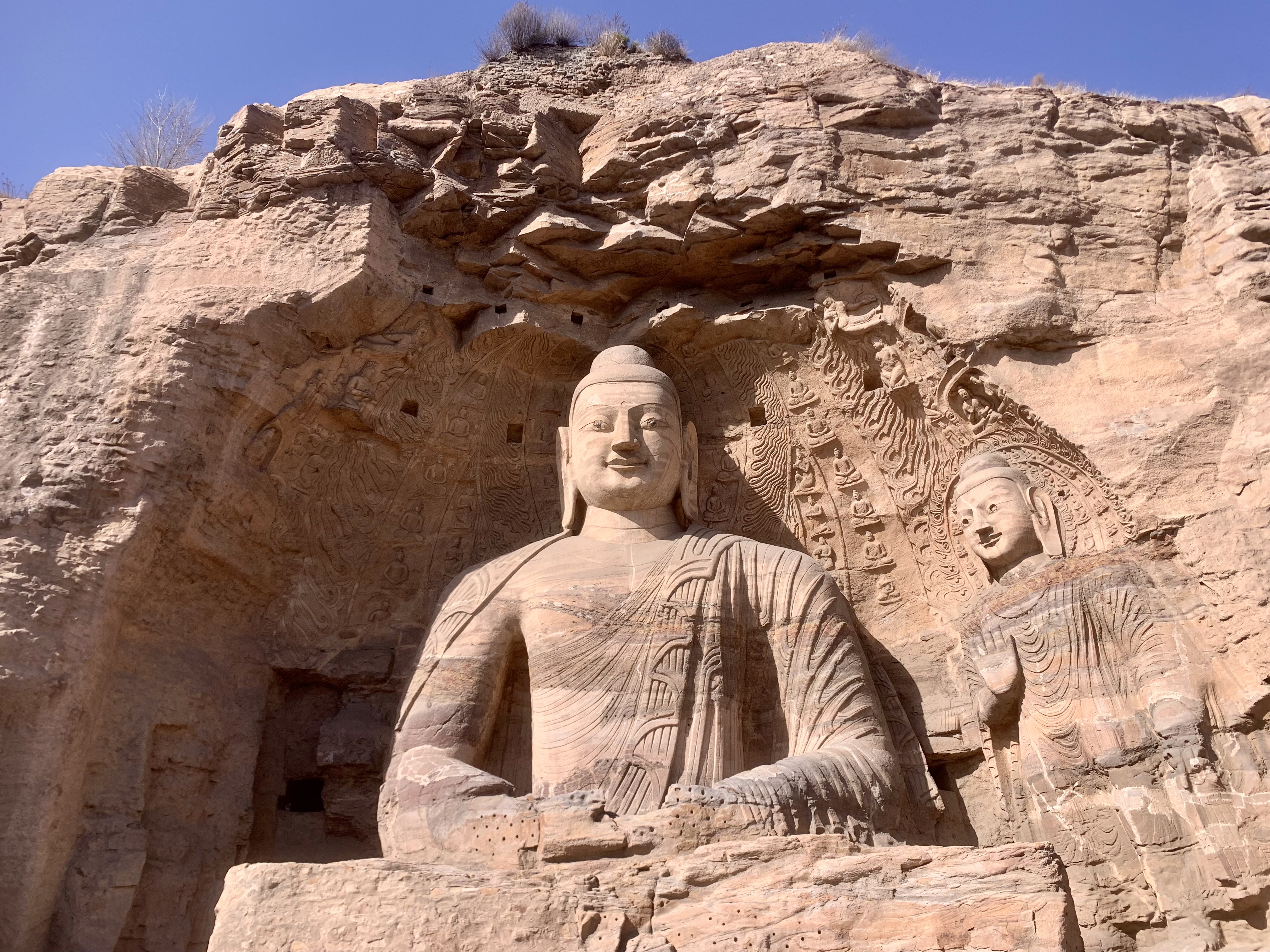
The photograph gives you a face. The site gives you a boundary.
The large seated figure at Yungang’s Cave 20 is easy to isolate in an image. A face, a patterned robe and the stone behind it can fill the frame until the cliff becomes background. Yet the edges matter. Where does carved space end and exposed rock begin? What happens when we look at a cave as a single statue? Those are useful questions to carry to Yungang Grottoes (云冈石窟), outside Datong (大同) in Shanxi (山西).
The photograph reproduced here records Cave 20 in March 2025. It is a way into the work, not a record of our own visit. Start with the folds across the body, then look away from the centre towards the surrounding stone and the nearby carved figure. The central Buddha is not the only thing the cliff has been made to hold.
A monumental image with an imperial setting
UNESCO describes the caves as a major fifth- to early-sixth-century Buddhist complex developed under Northern Wei imperial instructions. Its account places South and Central Asian Buddhist influences alongside Chinese traditions. This is a history of exchange and adaptation, rather than proof that an image belongs neatly to one isolated visual culture. [1]
The nomination dossier identifies Caves 16–20 as the five caves associated with Tan Yao (昙曜五窟), the earliest group carved at Yungang. It discusses their relationship to government patronage and the integration of different artistic traditions. Cave 20 belongs to that group; it should not be treated as an unrelated giant statue added to a scenic rock wall. [2]
Our interpretation: scale can do two kinds of work at once. It can offer a religious image that exceeds the viewer’s body, while also making the resources of its patrons visible. That does not reduce the sculpture to political propaganda. It gives a visitor a harder question: how can devotion, authority and the organisation of labour inhabit the same carved surface?
A photograph often makes the figure feel immediately available. The real viewing situation is organised by paths, barriers, crowd movement and the need to conserve the stone. Those limits need not spoil the experience. They remind us that visibility is managed, and that a place visited by many people cannot be treated as a private encounter arranged for one camera.
Read surfaces without inventing their history
Look at the relationship between the broad body and the repeated lines of the robe. In the reproduced view, folds give the large mass a rhythm that can be followed from a distance. Close detail is not the only route to attention. A carefully maintained viewing distance can make an overall relationship easier to grasp.
Do not assign an age to every visible patch from its colour alone. UNESCO notes past repairs and describes a conservation approach based on minimal intervention. Weathering, repair and surviving surfaces are matters for documented interpretation, not confident guesses from a holiday photograph. [1]
Likewise, the present open view should not become a claim that every cave offers the same experience. This route proposes comparing a large exposed composition with the idea of a carved interior, where available. It does not promise entry to any particular chamber or a complete circuit of all numbered caves.
A practical half-day from Datong
This is a proposed route based on heritage records and official visitor notices, not a firsthand-tested itinerary. Keep Yungang as the main event of a half-day, with travel time added. A crowded programme of distant monuments can leave you with a collection of facades and little time to understand one.
- Before leaving: secure the visit. Save 云冈石窟景区 and your booking confirmation. A notice published by Datong’s government on 14 April 2026 says the booking window changed to 15 days in advance, excluding the day itself, and requires advance real-name reservations for all visitors. Confirm current rules, your passport details and the booked slot through the official channels before travelling. [3]
- Arrange a return transfer. Use a Datong hotel as the starting point and agree the actual visitor entrance with the driver or accommodation. State pickup, waiting, parking and the return destination in writing. This plan does not rely on an unverified bus timetable or a fixed road journey time.
- Arrival and orientation: allow 30–45 minutes. Follow current visitor circulation and check the day’s cave openings before setting priorities. Ask which accessible paths reach the Tan Yao group. Use available labels or interpretation to establish the dates and numbering rather than treating a photograph as a navigation map.
- The Tan Yao group: allow about 60–90 minutes. Follow the permitted sequence towards Caves 16–20. Give Cave 20 an initial look without photographing it. Then compare figure, robe, surrounding rock and any secondary images visible from the public area. Make a short note on the relationship that survives when you stop framing the face alone.
- One contrasting space, then a return look. With roughly 30–45 minutes remaining, ask staff or your guide for an open cave or display that helps explain interior organisation. Choose from what is actually available. If access or crowds make that unsuitable, spend the time on interpretation and a second permitted view of the main group.
These allocations are editorial planning budgets, not operator tour durations. Add queues, toilets, rest and the transfer window. A limited-mobility visit needs a specific discussion of distance, surfaces, steps and currently available assistance; the words “half-day” establish none of those conditions.
Do not carry summer hours into October
An official summer notice extended opening for 11 July–31 August 2026. That date-limited notice cannot establish the opening or last-admission time on your October visit. Check the actual date through the Yungang Research Institute’s official channels. We quote no current ticket price, guaranteed cave entry or daily closing hour. [4]
Obey local photography and flash restrictions, barriers and staff instructions. Do not assume permission inside one cave follows permission at an outdoor viewpoint. A licensed archive photograph on this page does not grant visitors special photographic access.
A brief to send in Chinese
我们想从大同市区安排半日往返云冈石窟,重点了解昙曜五窟,尤其第20窟的造像、空间和修缮背景。请确认当天预约及护照要求、实际开放洞窟、步行距离与台阶、摄影规定,以及接送和等候费用。希望在允许参观的区域细看,不要求进入关闭洞窟,也不安排过于紧凑的远距离联游。
Ask a guide for one well-supported comparison, not a succession of superlatives. What makes the Tan Yao group distinct within the complex? Which historical claim comes from evidence, and which is interpretation? A useful visit should leave you with a more precise question than how many statues there are.
Plan the detour
Use our existing consultation form with your date, hotel, group size, walking needs and onward travel. Guiding, transport and personal coordination are separate services subject to confirmation. There is no new Yungang PDF announced here; check each existing guide’s preview and destination before purchase.
Send a trip brief ↗Browse existing PDF guides ↗Preview cultural member deep reads ↗Official sources & further reading
- UNESCO: Yungang Grottoes — Historic context, patronage, conservation and cultural exchange.
- World Heritage nomination dossier — Tan Yao’s Caves 16–20 and the early phase. Historical documentation, not visitor operations.
- Datong government: reservation notice — 14 April 2026; rules effective 15 April, subject to later updates.
- Pingcheng government: summer opening notice — Limited to July–August 2026, not used as October hours.
- Dudva: Cave 20 photograph — 22 March 2025, CC0; image record and rights.
