Start with what can be moved
A whole printing block carries the design of a page on one prepared surface. Movable type assembles separate characters into a page. UNESCO’s wooden-type introduction connects the practice in Rui’an with clan genealogies. The distinction is not that one produces beautiful books and the other ordinary ones; it concerns how a page is constructed. Look for the relationship between an individual character and the completed arrangement, and do not label every carved printing surface movable type.
Watch the work around printing
A sheet emerging from a press or hand-printing process is only one part of the work. Ask how characters are found, composed, checked and returned for future use. Sorting can be visually less dramatic than printing but central to understanding the system. In a museum, read the process labels before using a photograph as a technical illustration. A display might combine historic material, a reconstruction and a contemporary demonstration, and those distinctions matter.
Use the comparison in Yangzhou
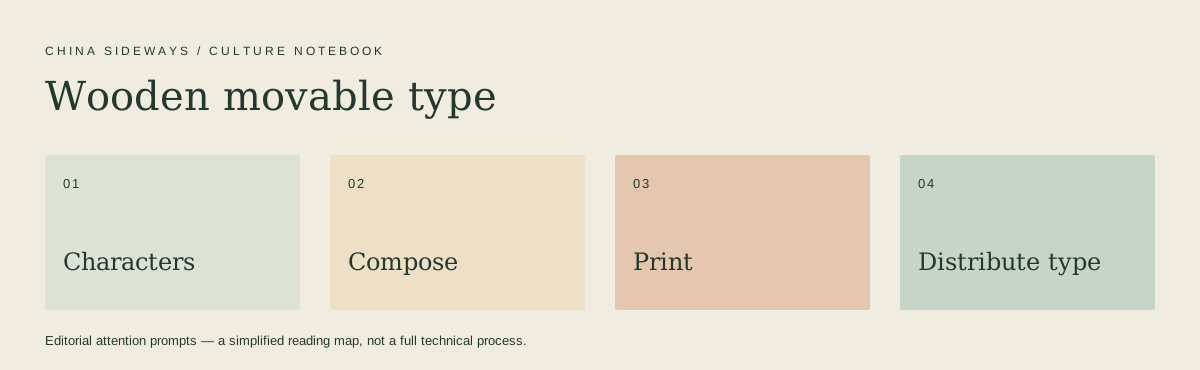
Our Yangzhou route centres on block printing rather than promising access to a Rui’an type workshop. That makes the two pages useful companions: one gives a destination framework, the other a comparison you can carry into a gallery. The simple diagram here describes a conceptual cycle, not the complete sequence of a particular workshop. When a guide uses the phrase traditional printing, ask which process they mean before choosing a class or buying a book.
Genealogy and wooden type: the book has a social purpose ↗
Source desk
Consulted 12 October 2026. Source pages establish cultural context; the viewing exercises and booking questions are editorial advice. No specific class, concert or private workshop is represented as currently bookable. Historical figures in heritage descriptions are not current practitioner statistics.