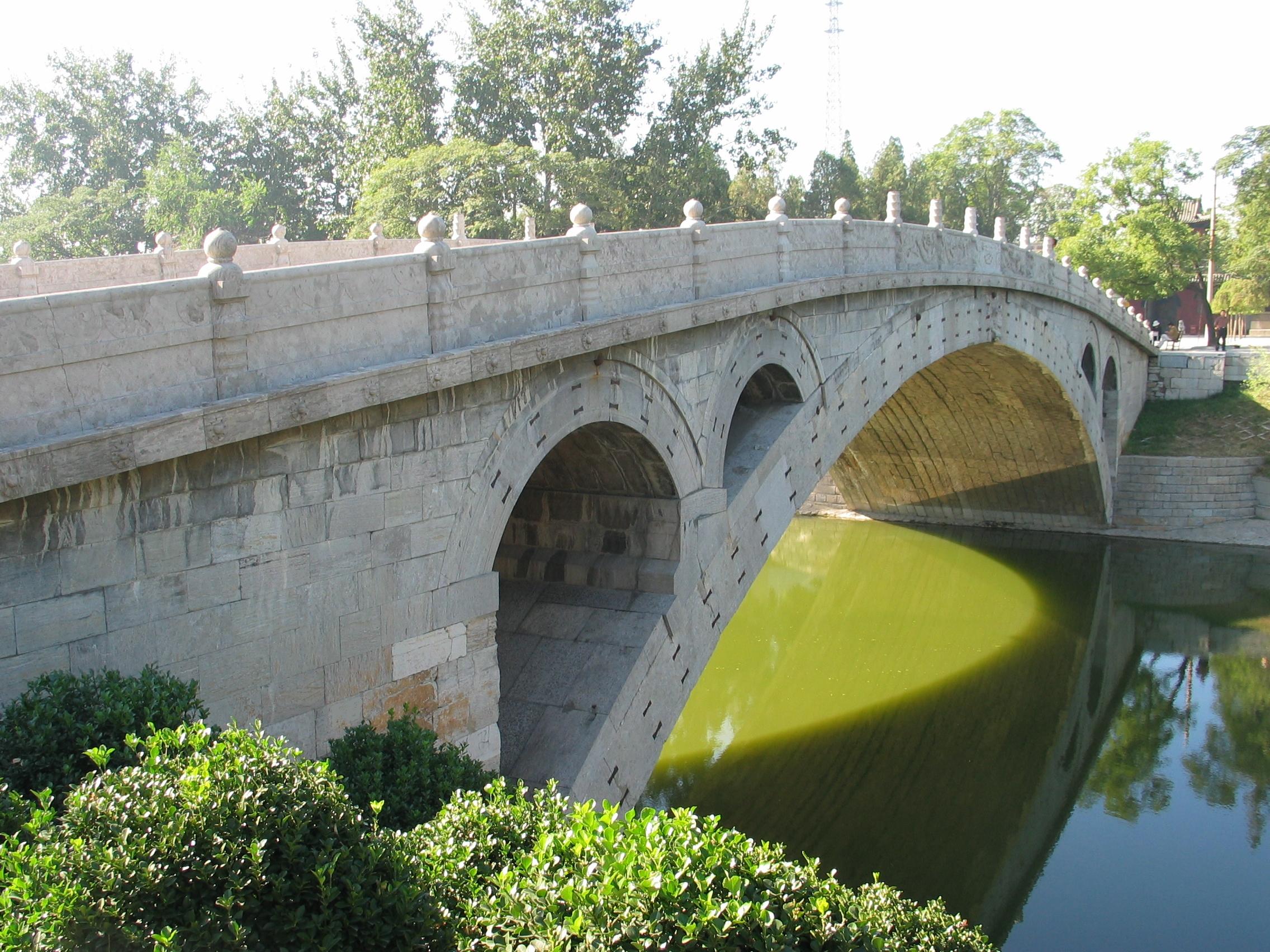
Four holes are part of the bridge
Stand where you can see the side of Zhaozhou Bridge, rather than beginning at the middle of its deck. The long main arch is easy to recognise. The stranger detail is above it: four smaller openings, two near each end. They make the bridge look lighter because there is, quite literally, less stone where a solid shoulder might have been.
The American Society of Civil Engineers describes these open spandrels as passages through which floodwater can flow above the main arch. A conservation account republished on a Shijiazhuang government website also explains the reduction in material and self-weight. The openings are not decorative windows added to an already complete structure. The absence is doing work. [1] [2]
That is a useful question to carry through a visit: which parts of a building matter because they are not there? The answer gives the bridge a more specific story than simply being very old.
One crossing, several names
The county’s heritage introduction calls it Zhaozhou Bridge (赵州桥), also Anji Bridge (安济桥) and locally Dashi Bridge (大石桥). It dates construction to 595–605, in the Sui dynasty, and credits the craftsman Li Chun (李春). The county record gives the main clear span as 37.02 metres. [3]
Those aliases belong in your phone. A translated hotel itinerary and a Chinese map search may use different names for the same object. Save the destination with its county: 河北省石家庄市赵县赵州桥. This is Zhao County in Hebei, not a vague request to find an “ancient bridge” near whichever city you happen to be visiting.
The heritage account also describes 28 arch ribs placed side by side. From a permitted viewpoint, try distinguishing the broad outline of the bridge from the smaller divisions within it. You do not need to reconstruct its engineering to notice that the single silhouette contains many parts. Do not enter the riverbed, climb a barrier or seek an underside photograph where access is restricted.
Old is not the same as untouched
A historic bridge is also a history of repair. The Shijiazhuang conservation feature distinguishes museum-displayed early railing material from the bridge as visitors see it, and shows conservation work on stone elements. Treat labels, replaced components and monitoring as part of the subject, rather than searching for an imaginary object outside time. [2]
Our viewing exercise: make three notes. First, sketch the main arch and the four smaller openings. Second, record one detail that you can actually see. Third, copy one statement from an interpretive label. Keep those categories separate: a visible joint does not tell you its date, and a beautiful carving does not establish that every neighbouring stone is original.
A manageable day from Shijiazhuang
This is a proposed route, not a firsthand-tested tour. Use Shijiazhuang (石家庄) as the starting and finishing base. Reserve a full day, not a tight gap between trains.
- Arrange the outward and return journeys first. For the simplest version, obtain a written quote for a licensed car or guide covering Shijiazhuang → Zhaozhou Bridge → Bailin Temple → Shijiazhuang. Confirm the pickup address, return time, waiting, tolls and any parking charges. Let the operator estimate travel time for your actual departure point; do not turn a map’s best-case duration into a train connection.
- Visit the bridge in daylight. Allow roughly 90 minutes to two hours as our suggested viewing allowance. Begin with the lateral profile and its four openings, then use whatever deck and interpretation areas are open. Stop at the entrance notice for the day’s access conditions.
- Take a lunch break in Zhao County (赵县). Choose an open restaurant on the day and make dietary needs clear. There is no required shopping stop in this route.
- Continue to Bailin Temple (柏林禅寺), if open to visitors. The county places the temple about three kilometres from the bridge. Use the arranged vehicle or a local taxi rather than assuming this is a scenic pedestrian link. Allow around an hour for a respectful public-area visit; worship and local access rules take precedence. [4]
- Return to Shijiazhuang. Keep the evening flexible. If you want the bridge’s night programme instead, extend the car booking explicitly and arrange the late return before setting out.
Two dated details that change the plan
Night visits: a scenic-area notice dated 9 October 2026, republished on Hebei’s policy-information platform on 10 October, advertises free night admission through 31 December 2026. It also says performances can change or be cancelled in bad weather. This is a dated offer, not a promise that every activity is included or that a performance will run on your date. Reconfirm before planning a late journey. [5]
Buses: a county tourism notice from 18 September 2024 describes a holiday-only service from the Hebei Museum area to the temple and bridge. Its old departures and fare are not a current timetable. If travelling by public transport, ask your accommodation or the local operator to verify both directions for your date; otherwise use the arranged-return option above. [6]
The provincial culture-and-tourism department documented removal of the scenic-area entrance charge in November 2023. Free entrance does not make transport, food, performances or optional attractions free. Opening hours and any booking or identification requirements still need date-specific confirmation. [7]
Why pair a bridge with a temple?
The county’s temple account describes reconstruction as well as the survival of the Zhaozhou master’s pagoda. It is not a licence to call every present building ancient. The two stops offer a useful comparison: how a structure carries weight, and how a place carries continuity through changes in its buildings. [4]
There is no need to force them into one grand explanation. Let the bridge remain a bridge before making it a symbol. Four gaps, a low arch and a crossing are already enough to reorganise the way you look.
Source desk · checked 15 October 2026
- ASCE: Zhaozhou Bridge historic landmark — engineering explanation; not a live access notice.
- Shijiazhuang government: heritage and conservation feature — 9 May 2024; structure, stonework and repair.
- Zhao County government: bridge introduction — 26 June 2023; Chinese names and construction record.
- Zhao County government: Bailin Temple — 26 June 2023; location and reconstruction history.
- Scenic-area night-visit notice, via Hebei policy-information platform — notice 9 October, republished 10 October 2026; offer ends 31 December 2026.
- County tourism bureau: holiday bus announcement — 18 September 2024; historical service, not current departures.
- Hebei Department of Culture and Tourism: free-admission policy — 8 November 2023.
Further looking: follow the conservation feature’s original-host photographs and captions to compare architectural detail with maintenance. We link to these images rather than reproduce them without permission.
Route order, suggested viewing time and exercises are China Sideways editorial proposals. This is researched writing, not a claim of a personal visit. Historical sources do not establish today’s opening conditions.
China Sideways member deep reads
Explore longer cultural dossiers in the existing shared reading-room membership. Public features remain free.
Membership & free preview ↗